



By Anita Arabatzis , Founder of Trends Rugs
Updated August 2026
After more than 20 years working with rugs, I’ve learned that some of the most important decisions happen on the side nobody sees.
Most people choose a rug by looking down at it.
I often start by turning it over.
Colour matters. Size matters enormously. The fibre on the surface affects how a rug feels, wears, sheds and cleans. If you are still deciding between wool, polypropylene, polyester, jute and other fibres, our guide to the best rug materials for Australian homes covers those differences in detail.
But once the rug is on the floor, the surface you fell in love with is not the part touching your flooring.
Your floor lives with the underside.
Over the years, we have seen problems that had very little to do with colour, pile or style: discolouration under a rug on vinyl, marks on timber where grit had collected underneath, rugs travelling across carpet, and older tufted rugs leaving fine powder beneath them as their internal adhesive deteriorated.
None of that means there is one “bad” type of rug backing.
It means the relationship between the rug, its backing, the underlay and the floor beneath it matters far more than most people realise.
The face of the rug determines how it looks. The underside determines how it lives with the floor.
Before I recommend a rug or underlay, I mentally put it through three tests.
The Trends Rugs Three-Test Rule
When someone asks me whether a particular rug backing is safe for their floor, I do not begin with a list of materials.
I look at three things.
1. Chemistry
Can these materials safely remain in contact with each other?
This matters most where rubber, latex, PVC, foam or another synthetic compound is sitting on vinyl or a coated flooring surface.
A backing can provide excellent grip and still be unsuitable for the floor underneath.
2. Movement
Will the rug move, and what will move with it?
A woven cotton foundation may feel soft. A jute backing may feel coarse. Neither tells me the full story.
If either rug is sliding repeatedly with sand and grit caught underneath, the movement can matter more than the fibre itself.
3. Moisture
What happens if water gets under the rug?
A spill, wet shoes, a recently washed rug, a sliding door left open in the rain or a damp entrance can all introduce moisture where you cannot see it.
The question is not simply whether the rug can get wet. It is whether both the rug and flooring can dry properly afterwards.
Those three tests—chemistry, movement and moisture—are more useful than blanket rules such as “natural backing is always safe” or “rubber backing is best because it does not slide”.
Quick answer: what is the best rug backing?
There is no single best rug backing for every floor.
- Woven cotton or wool foundations are generally uncomplicated, but they often need help with grip.
- Jute and other coarse natural fibres can work very well, but movement and trapped grit deserve attention on timber and polished surfaces.
- Latex-backed tufted rugs are common and can last for years, but their internal adhesive can deteriorate as the rug ages.
- Felt backing provides cushioning and separation but does not necessarily stop movement.
- Woven action or secondary backings add structure, but should not automatically be treated as non-slip.
- Rubber and synthetic non-slip coatings can provide excellent grip, but compatibility with vinyl and particular coated floors should be confirmed.
- Rug underlay can improve stability, cushioning and separation, but the underlay itself must suit the floor.
“Non-slip” tells you what a product is designed to do. It does not tell you every floor it is safe to sit on for years.
What does “rug backing” actually mean?
This is one of the reasons customers receive conflicting advice. “Backing” can describe several completely different parts of a rug.
1. The woven foundation
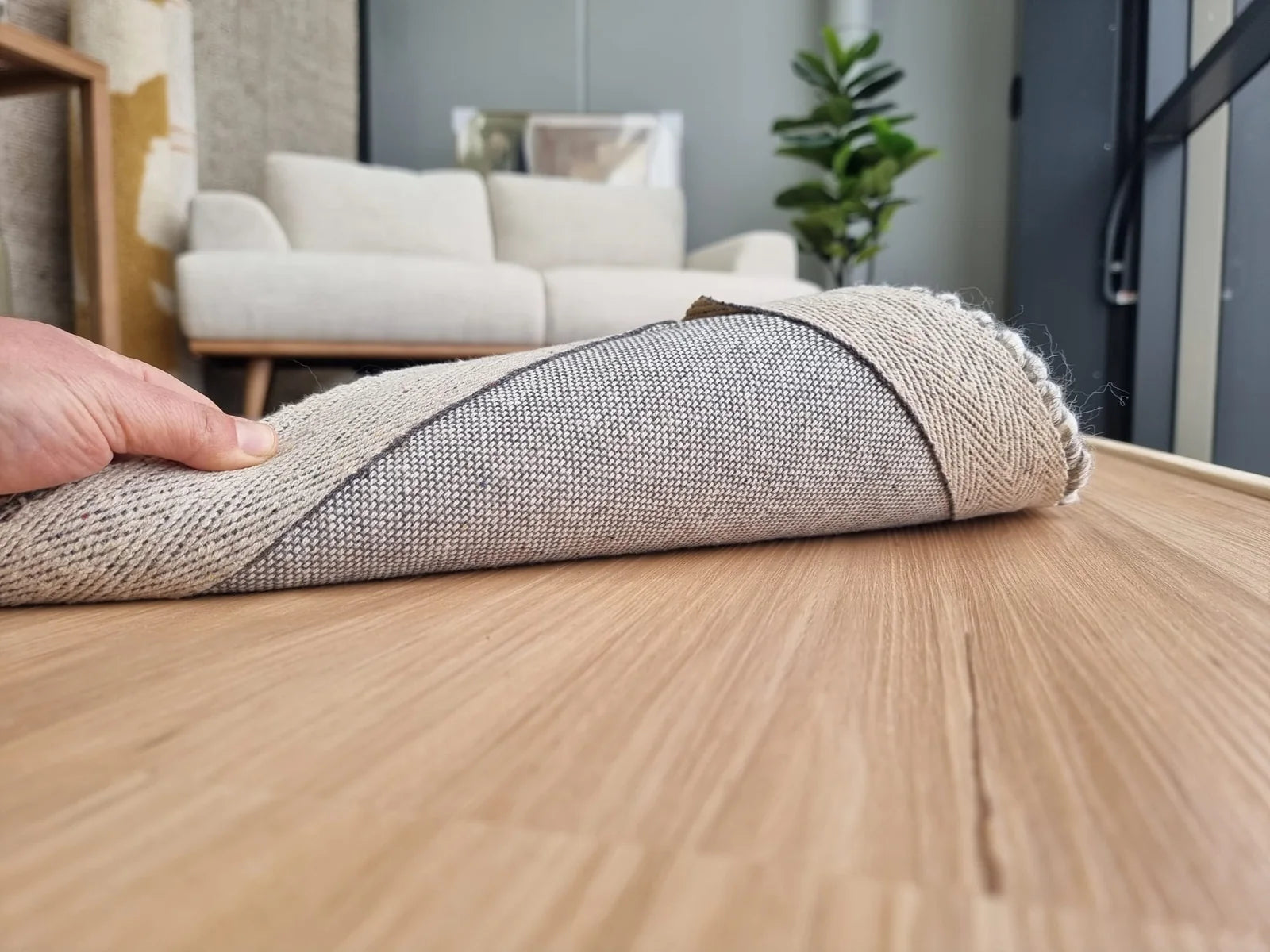
Turn over a hand-knotted or woven rug and you may see the pattern or construction directly on the reverse. There may be no separate backing attached at all.
The foundation can include cotton, wool or a combination of fibres. This is why describing a rug as “100% wool” does not necessarily tell you what is touching the floor. It usually describes the visible pile.
2. The structural adhesive
A hand-tufted rug is made differently. Yarn is pushed through a primary cloth and adhesive—commonly latex—is applied across the reverse to secure the tufts. A secondary cloth is then placed over it.
From underneath, the rug may appear to have a simple textile backing while an important structural layer remains hidden beneath it. The Association of Rug Care Specialists explains that ageing latex in tufted rugs can eventually break down into fine, sand-like powder.
3. The secondary backing
Felt, woven synthetic cloth, cotton, jute or another material may be added over the structural layer. It may strengthen the rug, hide adhesive, add cushioning or give the underside a finished surface.
What it does not necessarily provide is grip.
4. The non-slip layer
Some rugs have rubber, latex, PVC, TPR, foam or another compound added specifically to reduce movement.
That can be very useful on a small rug or runner, but good grip does not automatically mean good long-term compatibility with every flooring surface.
5. The separate rug underlay
Rug underlay is not actually part of the rug. It is the independent layer installed between the rug and the floor.
Once installed, the underlay may become the material permanently touching your flooring. That is why I treat choosing the underlay as a separate compatibility decision. Our complete Australian rug-underlay guide explains how we approach pads for timber, hybrid, laminate, vinyl, tile and carpet.
What I look for when I turn a rug over
You do not need to be a rug expert to learn something useful from the underside. You are simply looking for clues.
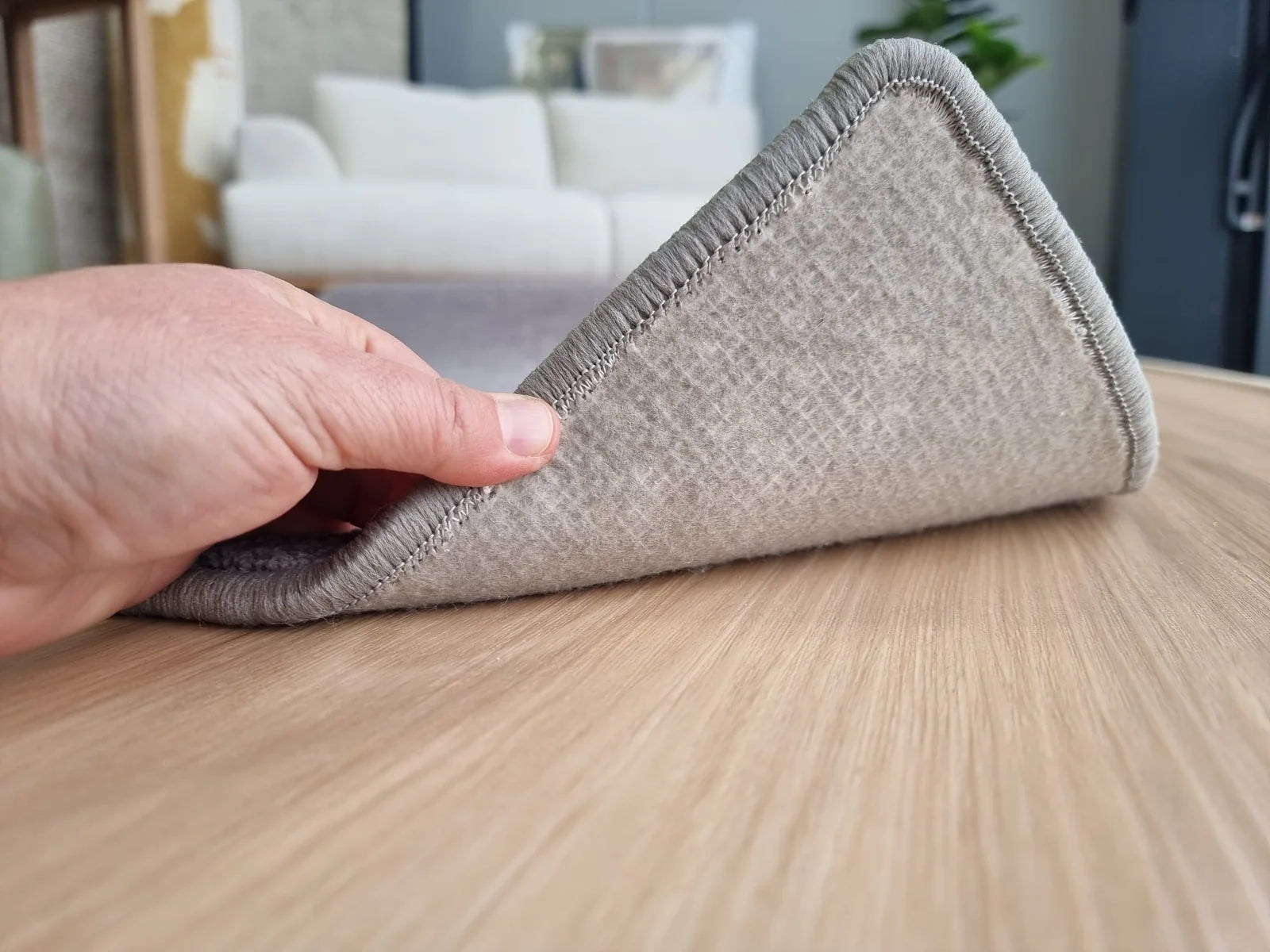
You see a textile or woven secondary backing
These backings can add structure and cover other layers in the rug. The exact construction varies, so I do not use the backing name alone to decide whether a rug will grip or whether it is suitable for the floor.
You see soft felt
Felt can provide cushioning and a softer contact surface. It does not automatically mean the rug will stay still.
You see a rubbery or latex grip layer
Now I want to know the exact flooring product—particularly if the rug will sit on vinyl or another floor with manufacturer restrictions.
You find pale powder underneath an older tufted rug
Look more closely at the rug itself. The problem may be ageing adhesive rather than dirt passing through from above.
Case study: what vinyl discolouration taught us
One of the situations that has made me particularly cautious involves vinyl.
We have seen a case where an area underneath a rug became discoloured where backing material had been sitting against the vinyl. It was not simply ordinary surface dirt that could be wiped away.
That matters because customers often think of vinyl as an especially tough flooring surface. It can be tough, but resistance to foot traffic and compatibility with another material are two different questions.
Karndean Australia warns that rubber can permanently stain vinyl flooring and advises the use of non-staining rugs and mats, including where latex or rubber backing is involved.
That is enough for me to reject one of the most common assumptions I hear:
“It says non-slip, so it should be fine.”
Not necessarily.
What we learned from that case
When somebody tells me they have vinyl, I do not immediately recommend a generic rubber pad. I want to know:
- Who made the flooring?
- What type of vinyl is it?
- Does the flooring manufacturer restrict rubber or latex?
- Does the rug or underlay manufacturer specifically confirm compatibility?
- Can that compatibility be confirmed in writing?
A rug pad is inexpensive compared with replacing a floor. I would rather be cautious than discover the problem years later when the rug is moved.
Case study: what marks underneath a timber rug taught us
The timber case taught us something different.
The obvious question was:
“Did the rug backing scratch the timber?”
But what mattered was what had accumulated underneath it.
There was fine grit beneath the rug, and the rug had been moving.
That combination changed the way I explain timber protection to customers. A homeowner can protect chair legs and furniture carefully, then cover several square metres of timber with a rug and never look underneath it again.
Meanwhile, ordinary household dust and grit slowly work their way underneath. If the rug shifts with foot traffic, those particles move too. In that situation, the grit can effectively become the abrasive layer.
What we learned from that case
When protecting timber, I care about three things:
Cleanliness. Stability. Separation.
- Lift the rug periodically.
- Vacuum or clean underneath it.
- Inspect the floor before putting it back.
- Check whether the rug has been moving.
- Inspect the underlay if one is being used.
- Reinstall everything only when the floor is clean and dry.
The underlay may reduce movement and create separation. It does not remove the need to check what is happening underneath.
Backing types and what they actually do
Jute backing on timber: is it actually a problem?
Jute is strong, natural and widely used in rug construction. It is also relatively coarse.
Does that mean every jute-backed rug will scratch timber? No.
The question I care more about is whether the backing can move repeatedly over the floor and whether anything abrasive is trapped between the two.
A large rug held in place by furniture on a clean floor is a very different situation from a narrow runner moving backwards and forwards in a hallway every day.
That is why I think movement plus grit is a more useful way to understand the risk than simply labelling jute as good or bad.
Action and woven secondary backing: structure is not grip
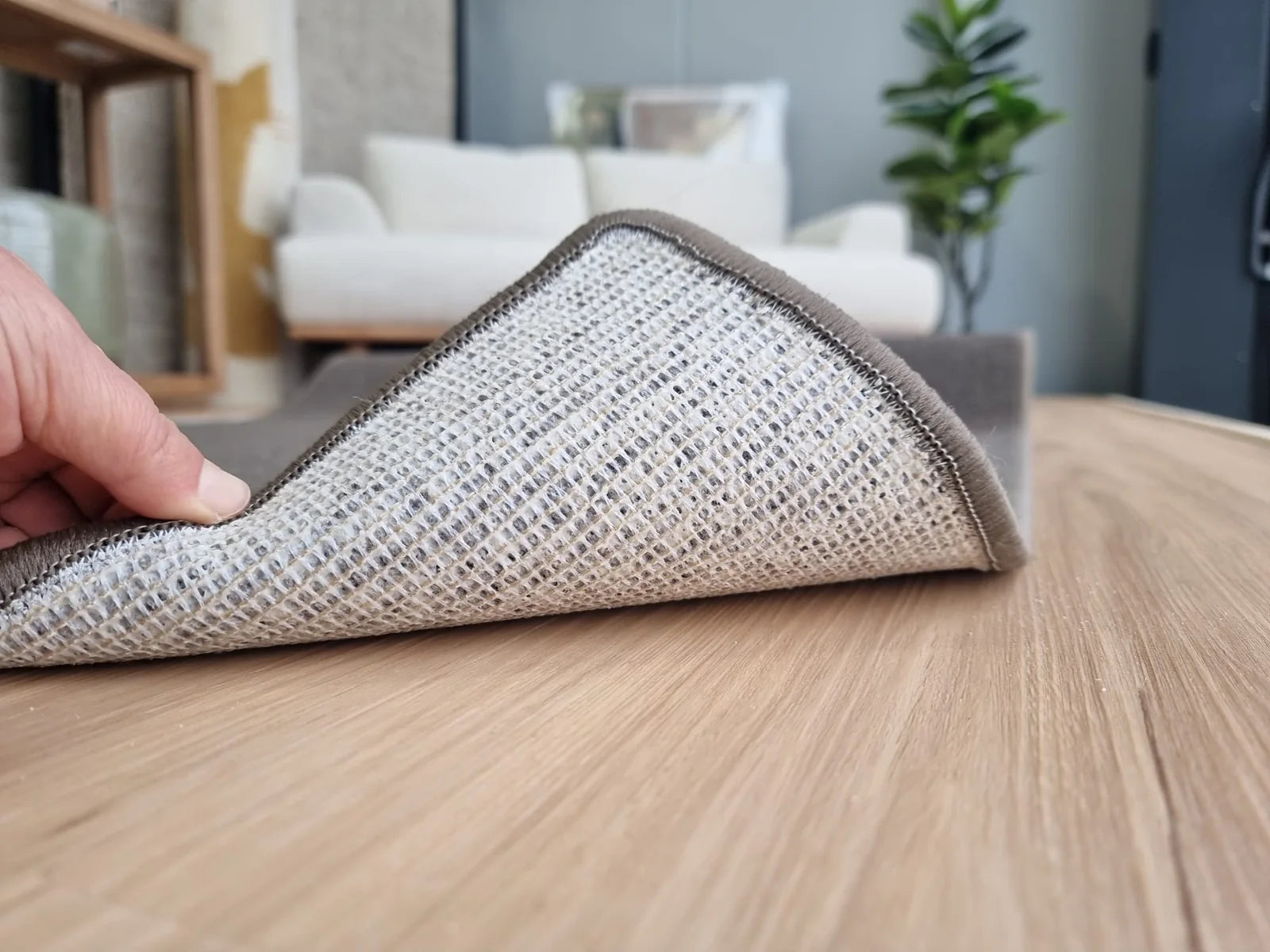
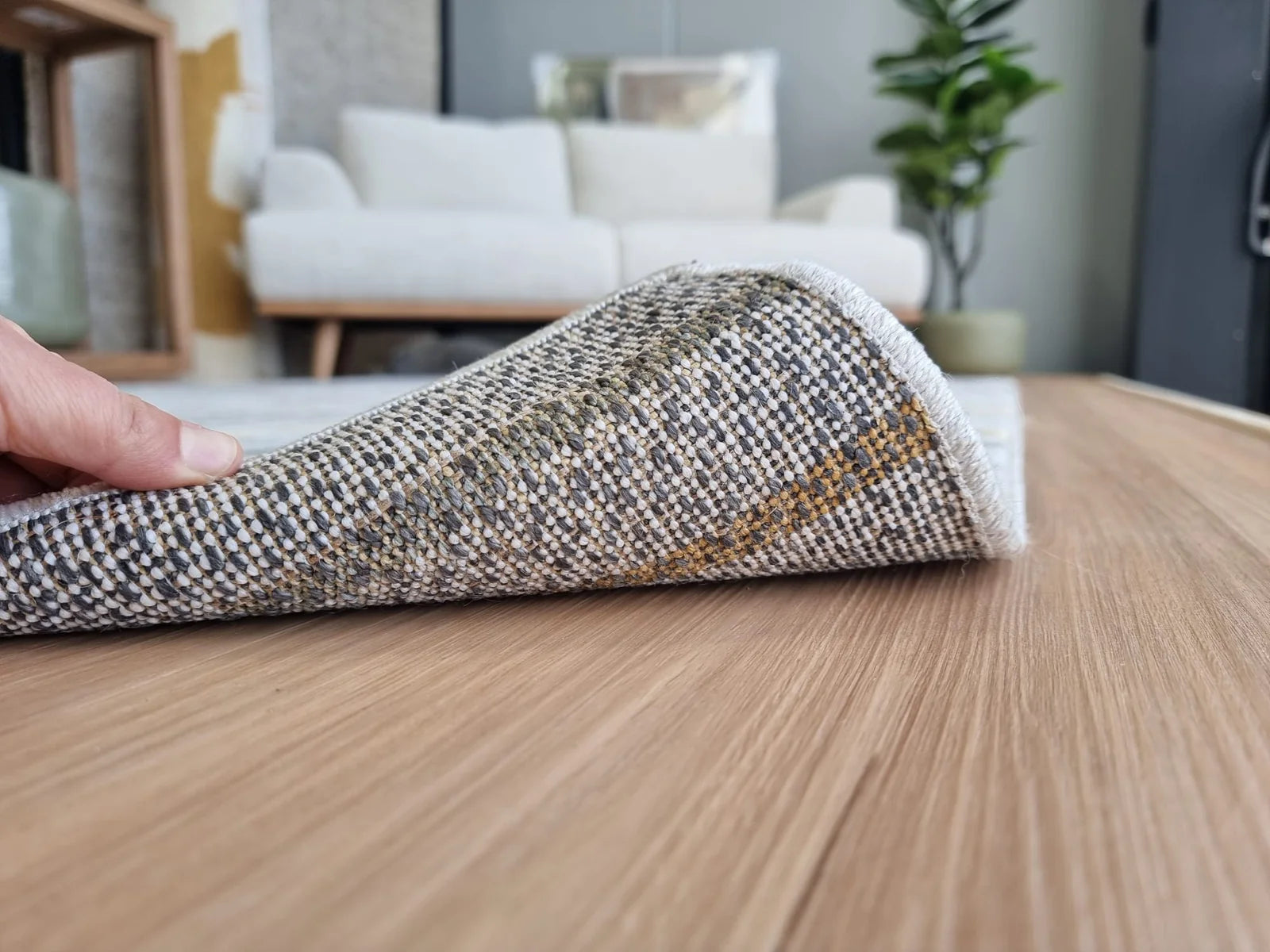
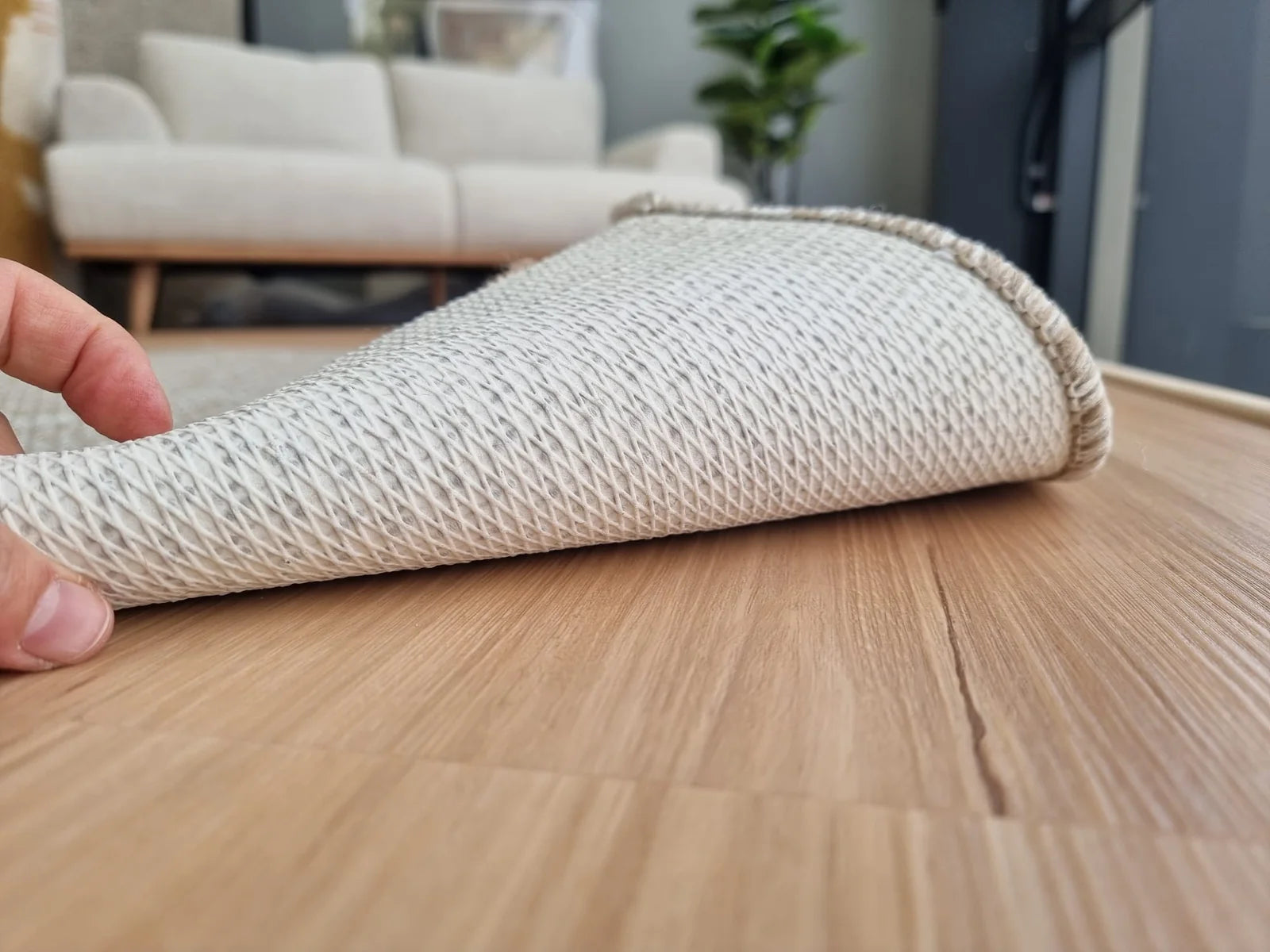
In the rugs we handle, we see several woven secondary backing constructions, including examples described as action backing. These layers can add support and dimensional stability to the rug, but the backing name alone does not tell me whether the rug will stay in place or whether it is compatible with a particular floor.
The two real examples above—nylon action backing and cotton action backing—show why I prefer to look at the complete construction rather than rely on one label.
Felt backing: softer does not mean stationary
Felt provides cushioning, body and a softer layer under the rug. It can also help with sound.
But one mistake I see is assuming that because felt feels soft and substantial, it will stop the rug moving.
Not always.
A large rug partly anchored by furniture may sit beautifully. A smaller felt-backed rug or runner on a smooth floor can still move.
That is why I separate cushioning from grip.
Rubber and latex backing: excellent grip, but check the floor
Rubber and other synthetic non-slip backings solve a genuine problem: they can stop smaller rugs moving.
But a hard floor is not one material. Vinyl, engineered timber, laminate, hybrid, polished concrete, porcelain tile and sealed stone can all be described as hard flooring while having very different surface chemistry and care requirements.
The broader lesson is the one I follow in store:
Check the instructions for the floor you actually own—not a floor that simply looks similar.
Latex-backed tufted rugs and the mysterious powder underneath
Someone lifts an older rug and finds pale granules or fine powder beneath it. The natural assumption is that sand has somehow travelled through the rug.
Sometimes the material is coming from the rug itself.
Tufted rugs commonly use latex adhesive to hold the yarn in place. As that latex ages, it can become brittle, lose adhesion and eventually form fine powder. The secondary backing may also begin to ripple or separate.
Signs I would look for include:
- pale powder or granules;
- backing cloth starting to ripple;
- brittle or cracked areas;
- cloth pulling away from the construction;
- new movement that was not present when the rug was younger.
A suitable rug pad can separate some loose material from the flooring. It cannot repair failing adhesive inside the rug.
Matching rug backing to the floor
Timber and engineered timber
My main concerns are movement, trapped grit, the flooring finish and any manufacturer restrictions on backing or underlay materials.
A stable woven rug with a suitable underlay is often a straightforward starting point, but the floor should still be cleaned and inspected periodically.
Timber can also change colour with UV exposure, so covered and uncovered areas may age differently. A visible outline when a rug is moved is not automatically evidence of backing damage.
Vinyl flooring
Vinyl deserves particular attention around rubber, latex and other grip compounds because some materials can discolour the surface.
“Non-slip” and “vinyl-compatible” are different claims. I would confirm compatibility with the exact floor before leaving a backing or pad in permanent contact with it.
Hybrid flooring
Hybrid is a broad category. Different products use different surface layers, core constructions and care requirements.
I look at how much the rug moves, whether grit is accumulating, what the rug backing is made from, what the underlay is made from and what the flooring manufacturer permits.
Laminate flooring
With laminate, I think people spend too much time thinking about scratches and not enough about hidden moisture.
If a spill gets underneath a rug, lift the rug and pad, dry the floor, allow everything to dry fully and only then reinstall it.
Rugs on carpet follow different rules
Put a rug on timber and it sits on a relatively fixed surface. Put it on carpet and the surface beneath it compresses and moves.
That is why rugs on carpet can creep, ripple and “walk” even when they feel reasonably heavy.
In our showroom experience, a firm, structured rug generally behaves more predictably over lower-profile or loop-pile carpet than a very lightweight rug over deeper directional pile. Rug size, carpet construction, furniture and traffic all change the result.
Our guide to putting rugs over carpet properly covers this separately because it really is a different problem from slipping on hard flooring.
Washable rugs: inspect the underside after washing
Washable rugs have solved a real problem for homes with children, pets and regular spills, but “washable” describes how a rug can be cleaned. It does not tell you everything about the underside.
Some washable rugs have an integrated non-slip backing, while others rely on a separate pad.
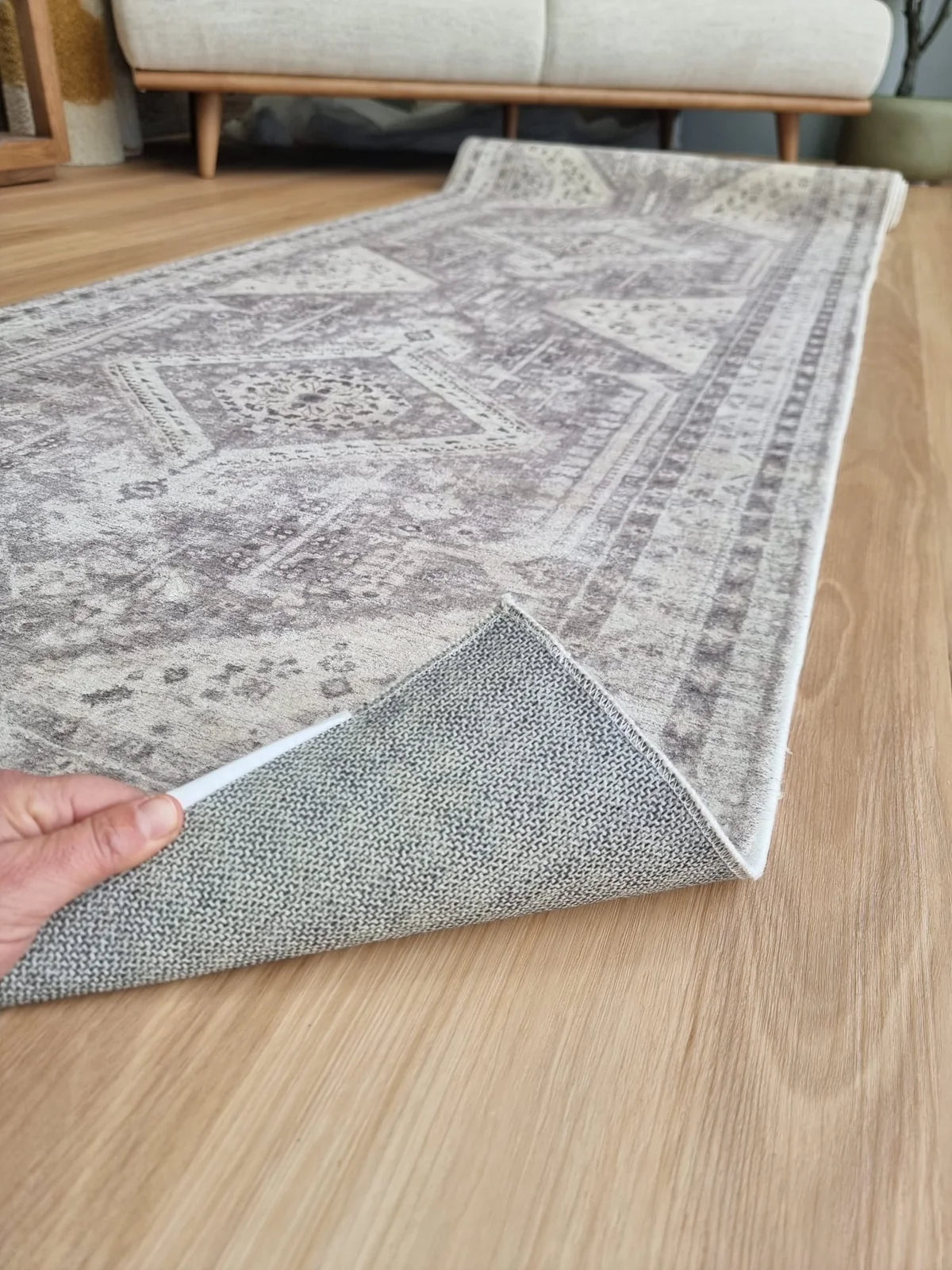
After washing, look for curled edges, cracking, stiffness, loss of grip, distortion or sections that no longer sit flat. Make sure the rug, underlay and floor are completely dry before reinstalling.
Our Australian washable-rug guide goes deeper into the trade-offs between maintenance, construction, durability and everyday family use.
The Trends Rugs rug-backing decision matrix
Instead of asking “Which backing is best?”, I think this is a more useful way to diagnose what is actually happening.
| What you notice | What may be happening | Floor worth checking carefully | What I would do first |
|---|---|---|---|
| Rug continually shifts | Lack of grip | Timber, hybrid, laminate, tile | Clean underneath and use a compatible pad if needed |
| Grit beneath a moving rug | Abrasive movement | Timber and coated floors | Clean, stabilise and inspect the finish |
| Rubberised backing | Possible material interaction | Vinyl first; also check coated floors | Confirm manufacturer compatibility |
| Coarse natural backing | Movement may increase abrasion | Timber and polished surfaces | Stabilise and create separation if required |
| Pale powder under a tufted rug | Possible ageing latex adhesive | Any flooring | Inspect the rug construction |
| Damp beneath a rug | Moisture trapped out of sight | Laminate, timber, some hybrids | Lift everything and dry completely |
| Felt-backed rug still slides | Cushioning without enough grip | Smooth hard floors | Consider a suitable gripping layer |
| Rug creeps or ripples over carpet | Carpet pile movement | Carpet | Use a carpet-specific solution |
| Backing changes after washing | Cleaning or age affecting construction | Any | Inspect before reinstalling |
This table is a diagnostic starting point, not a universal compatibility certificate. The flooring manufacturer's current instructions should always take precedence.
The five-minute rug check I recommend at home
You do not need to wait for something to go wrong.
Every few months—particularly in busy rooms—do this:
1. Lift a corner
Does the rug release cleanly? Anything sticky, powdery or unusually brittle deserves investigation.
2. Look at the floor
Check for fine marks, dull areas, discolouration, residue, damp or a defined outline around the rug.
3. Look at the rug backing
Check for cracking, powder, loose fibres, separating cloth, hardening, sticky areas or curled edges.
4. Check the rug pad
Has it moved, flattened, crumpled, started breaking down or transferred anything to the floor?
5. Clean before putting everything back
Vacuum or clean appropriately, allow the floor, rug and pad to dry fully, then reinstall everything flat.
Five minutes of inspection can tell you more than years of never moving the rug.
Do you actually need rug underlay?
Not every rug needs exactly the same solution.
I am most likely to recommend a pad when:
- the rug moves;
- a runner slides;
- the backing is coarse;
- separation from a delicate finish would help;
- the rug is being placed over carpet;
- a lightweight rug ripples;
- extra cushioning is wanted;
- a washable rug has lost some stability.
But I do not believe in treating underlay as something every customer must buy automatically.
It should solve a real problem, and it must suit the floor.
If underlay is appropriate for your situation, you can view our rug pads and non-slip rug underlays. For vinyl, specialist timber finishes or any flooring with specific warranty conditions, I would still check the flooring manufacturer's instructions first.
My opinion: rug labels do not tell customers enough
This is something I would genuinely like to see improve across the rug industry.
A label might say 100% wool. That is useful, but it mainly tells me about the visible pile.
I would also like customers to be able to easily find:
- the foundation material;
- whether structural adhesive is used;
- the secondary backing material;
- the type of non-slip coating;
- known flooring restrictions;
- whether separate underlay is recommended.
The underside of a rug may sit against an expensive floor for years.
“Natural backing” is not enough information. “Cotton backed” may not describe the complete construction. “Non-slip” does not tell me whether a compound is suitable for vinyl.
I think better backing disclosure would prevent avoidable problems and make it easier for both rug retailers and flooring retailers to give accurate advice.
Until that happens, I still recommend the simplest inspection possible.
Turn the rug over.
Frequently asked questions about rug backing
What is the safest rug backing for timber floors?
There is no universally safest material. A stable woven foundation with a compatible underlay is often a straightforward starting point. Movement, grit, the timber finish and any flooring-manufacturer restrictions also matter.
Can rubber-backed rugs damage vinyl flooring?
Some rubber compounds can permanently discolour vinyl. Check the exact flooring manufacturer's care instructions before using a rubber-backed rug or rug pad.
Can jute backing scratch timber?
Jute does not automatically scratch timber. Risk increases where a coarse backing and trapped grit move repeatedly over a susceptible finish.
Why is there sand-like powder under my rug?
If the rug is tufted, pale powder can be a sign of deteriorating latex adhesive rather than sand from above. Check for loose secondary cloth, stiffness, cracking or separation.
Does felt backing stop rugs slipping?
Not necessarily. Felt can provide cushioning and a softer contact layer without providing enough grip on a smooth floor.
Does every rug need a rug pad?
No. Rug size, weight, backing, furniture placement, flooring and movement all affect whether underlay is useful.
Is a non-slip rug pad safe for vinyl?
Not automatically. “Non-slip” and “vinyl-compatible” are different claims. Confirm suitability for the specific flooring.
Can I put a rug straight onto hybrid flooring?
Often, but lightweight rugs may move and manufacturers can have different care requirements. Check the particular hybrid floor and use a compatible underlay if stability is needed.
What type of pad should I use under a rug on carpet?
Use an underlay specifically intended for rug-on-carpet applications rather than automatically using a product designed for a smooth hard floor.
How often should I lift and clean underneath my rug?
There is no universal timetable because traffic, pets, entrances and household conditions vary. I recommend checking periodically and more often in areas where grit, moisture or movement are likely.
After more than 20 years, this is the rule I trust
The longer I have worked with rugs, the less interested I have become in absolute statements:
Wool is always best.
Rubber is safest.
Natural backing will not damage timber.
Heavy rugs do not need underlay.
If it says hard-floor safe, it is safe for every hard floor.
Homes do not work that way.
Neither do rugs.
The same backing can behave perfectly well in one room and cause problems in another because the flooring, traffic, moisture or movement is different.
So I do not believe the smartest question is:
“What is the best rug backing?”
I think the better question is:
“What will happen when this particular rug sits on this particular floor in this particular home?”
That question takes the rug, the floor, the backing, the underlay and the way the household actually lives into account.
A good rug should do more than look right when it first goes down.
It should work with the surface underneath it for years.
And sometimes the best way to start making that decision is still the simplest:
Turn the rug over.
About Anita Arabatzis
Anita Arabatzis is the Founder of Trends Rugs, an Australian rug retailer with more than 20 years of hands-on experience helping homeowners choose rugs, materials, sizing and underlay. Through the Trends Rugs South Morang showroom and online store, Anita and the team regularly advise customers on rug construction, floor compatibility, maintenance and the practical problems that only become obvious after a rug has been living in a home.


